The government has prioritized the creation of a public service in Sri Lanka that is free from bribery and corruption, while upholding the integrity of public officials. As a key initiative to curb corruption within the public sector, Internal Affairs Units (IAUs) have been established across all government ministries, departments, and institutions. These units aim to foster a culture of transparency, accountability, and integrity, ensuring the effective delivery of government services to all citizens.
Key Objectives of the Internal Affairs Unit
- To prevent corruption within the institution and foster a culture of integrity.
- To ensure transparency and accountability in all institutional activities and guarantee public access to information regarding institutional operations and decisions.
- To promote ethical governance within the institution.
- To establish a safe and accessible mechanism for encouraging the reporting of misconduct, protecting whistleblowers, and maintaining confidentiality.
- To assist in law enforcement by collaborating with law enforcement agencies and the Commission to Investigate Allegations of Bribery or Corruption.
Responsibilities and Functions of the Internal Affairs Unit
- Examining current procedures and circulars to identify systemic bottlenecks within the institution and simplifying them to enhance operational efficiency.
- Conducting corruption risk assessments to identify areas within the institution vulnerable to corruption and unethical behavior, and implementing targeted preventive measures.
- Formulating and implementing an institutional integrity action plan that incorporates specific anti-corruption objectives and strategies tailored to the institution's needs.
- Ensuring alignment with national anti-corruption strategies by harmonizing institutional policies and practices with the National Anti-Corruption Action Plan.
- Conducting compliance assessments to evaluate the institution's adherence to national and international anti-corruption laws—including the Anti-Corruption Act No. 9 of 2023—and identifying areas for improvement.
- Ensuring compliance with asset declaration requirements for all public officers and employees, and managing conflicts of interest in accordance with the directives of the Commission to Investigate Allegations of Bribery or Corruption and the Anti-Corruption Act No. 9 of 2023.
- Establishing a secure system to receive and manage complaints regarding corruption and unethical conduct within the institution; ensuring that relevant officers or units take prompt action on all such complaints; and providing regular updates to inquiring stakeholders while ensuring transparency and accountability.
- Referring relevant matters, findings, or information to the Commission to Investigate Allegations of Bribery or Corruption for investigation under the Anti-Corruption Act, as required.
- Developing and publishing a Citizens' Charter outlining the services provided by the institution.
- Establishing and enforcing policies that promote ethical governance, including a standardized code of conduct to be adhered to by public officials.
- Taking measures—such as staff training and awareness-raising—to foster commitment to anti-corruption principles.
- Acting as the institutional focal point for the National Anti-Corruption Integrity Assessment, ensuring the institution’s participation in and alignment with integrity assessment processes led by the Commission to Investigate Allegations of Bribery or Corruption and the National Anti-Corruption Framework.
- Maintaining liaison with the Commission to Investigate Allegations of Bribery or Corruption to obtain continuous guidance and support in carrying out the unit's duties.
- Preparing periodic and annual reports summarizing the activities of the internal unit, the progress of anti-corruption initiatives, challenges encountered, and recommendations for future action.
- Formulating and implementing plans to enhance integrity with the participation of private sector stakeholders.
Members of the Internal Affairs Unit, Chief Secretary's Office, Central Province
Head of the Internal Affairs Unit
Mrs. Sujani R.Wijethunga - Deputy Chief Secretary (Admin)
Members
- Ms. K.A.D. Ariyawansha - Chief Engineer (Technical)
- Mr. D.M.L.K. Dassanayake - Deputy Director (Planning)
- Ms. K.A.N. Damayanthi - Director (Finance)
- Ms. T.P. Dehigolle - Director (Management Development and Training Unit)
- Ms. A.J. Karunaratne - Legal Officer.
- Ms. K.A.M.M. Gunathilaka - Deputy Director (Planning)
- Mr. T.M.K. Rathnayake - Assistant Chief Secretary (Administration)
- Ms. Chandrika Dassanayake - Administrative Officer
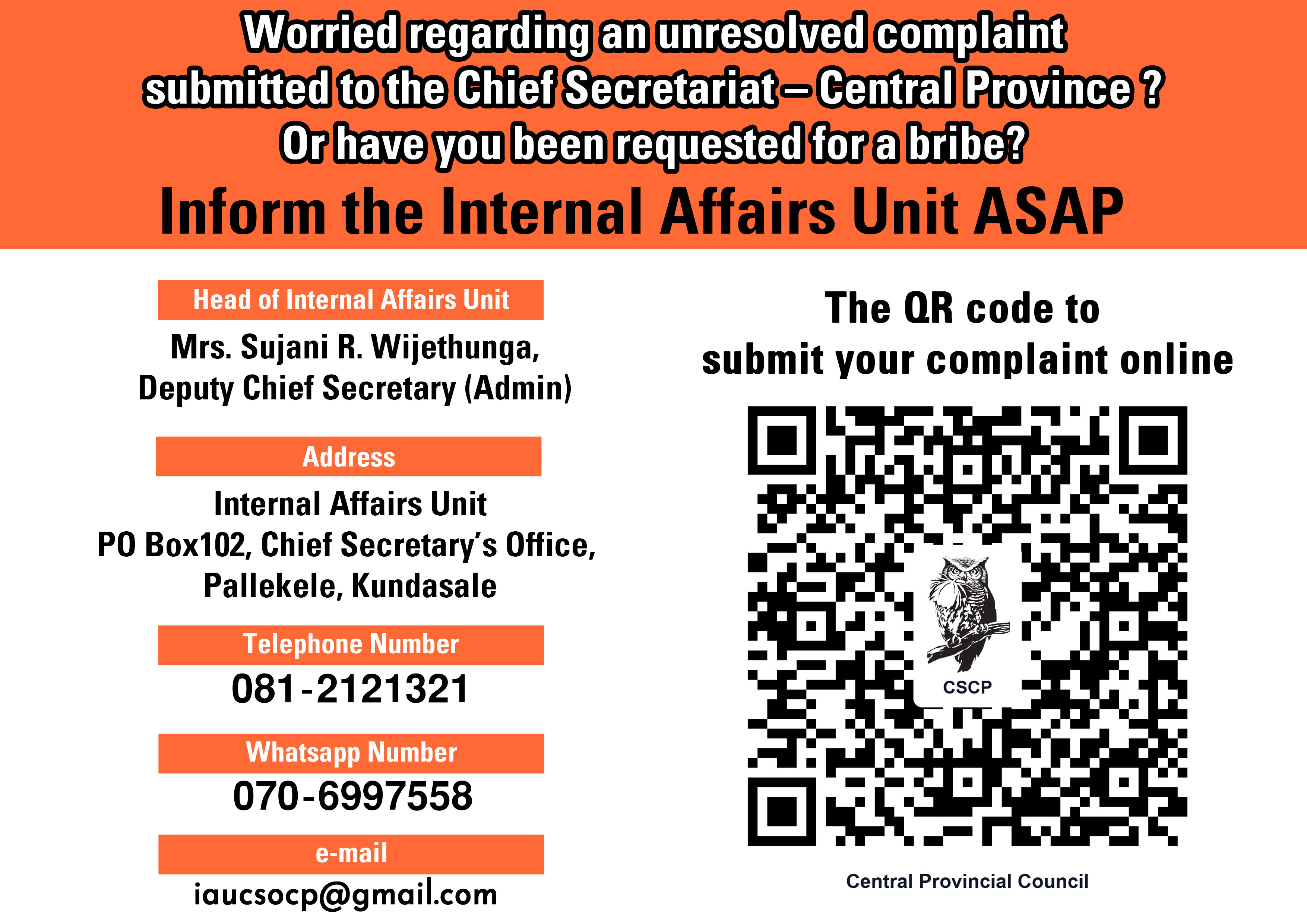
If you have a complaint regarding bribery or corruption concerning services provided by the Chief Secretary's Office, Central Province or involving an officer of the Chief Secretary's Office, Central Province, you may submit your complaint to the Internal Affairs Unit of the Chief Secretary's Office, Central Province via the following procedure:
Code of Ethics for the Chief Secretarys office - Central Province ⬇